

Recently, we have received a large number of inquiries about automatic handling projects. Meanwhile, some customers cannot clearly tell the difference between fully automatic and semi-automatic models. This article gives a detailed explanation of their functions and key differences.
aGV
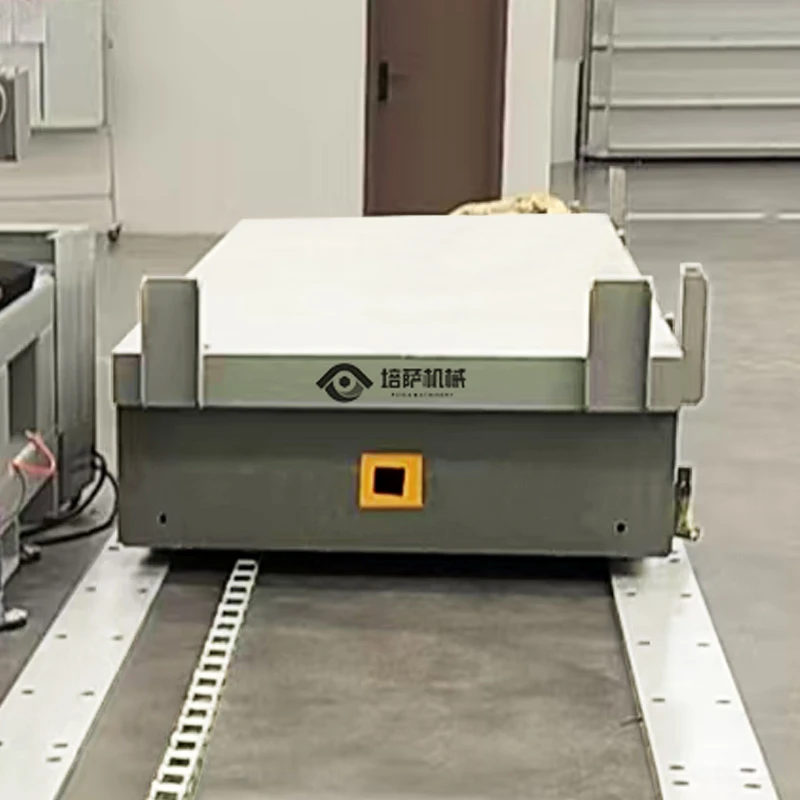
PEISA is capable of designing and manufacturing customized fully automatic transfer trolleys.
What defines a fully automatic model?
No manual intervention required during operation
Independent route planning and automatic traveling
Automatic obstacle recognition, collision avoidance and precise parking
Three mainstream navigation methods are available: magnetic strip navigation, laser navigation and QR code navigation. The trolleys travel strictly along preset routes without any position deviation.
One essential condition for full automatic operation is a scheduling system. Simply put, automatic trolleys need task instructions from an upper system instead of manual control. They receive orders from central control or connected equipment and execute transportation tasks automatically.
Typical project case:We once delivered a fully automatic rail transfer trolley for one factory. The trolley received working instructions from overhead cranes through reserved PLC interfaces, and all trolley data was integrated into the customer's factory scheduling system.
When a crane starts lifting work, it sends a task command to the trolley. The fully automatic trolley then travels to the designated working position automatically. The whole process requires no manual participation at all.
Matched with professional scheduling system
Higher overall investment cost
Ultra-high positioning and running accuracy
Ideal for heavy-load and non-stop continuous transportation
Suitable for workshops with fixed layout and long-term unchanged traveling routes
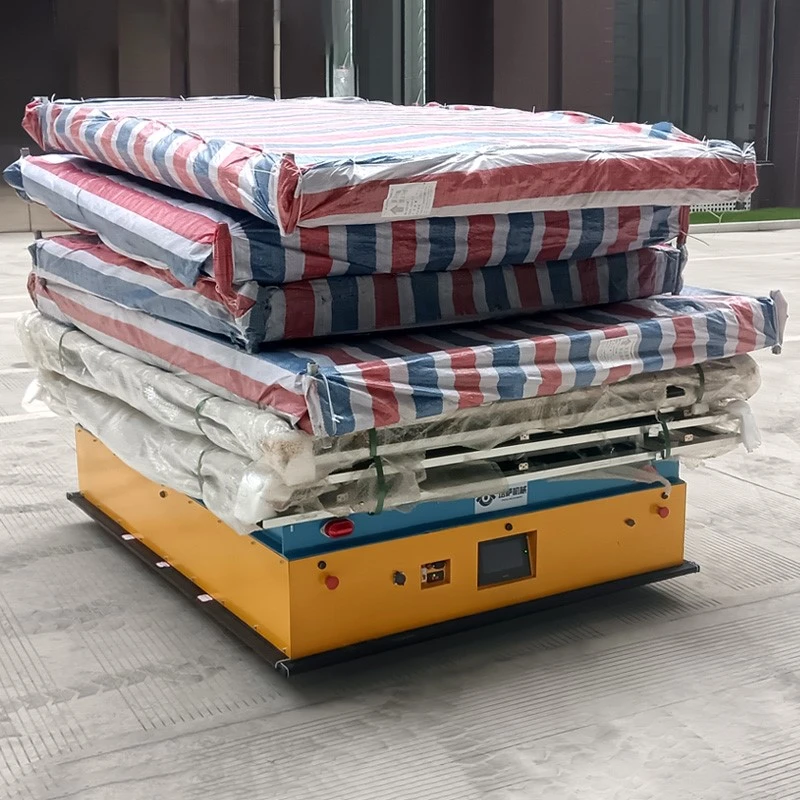
Semi-Automatic Transfer Trolley
A semi-automatic transfer trolley adopts a collaborative working mode between operators and equipment. Key operations such as start-up, steering, parking and route switching rely on manual operation or remote control. Only partial functions like constant-speed traveling, fixed-point parking and basic obstacle avoidance run automatically.

Main types include:
Remote-control assisted transfer trolleys: controlled via wireless remote controllers with automatic anti-collision and limit protection functions
Semi-automatic RGV / AGV: runs automatically along preset routes, while task switching, station adjustment and emergency handling need manual support
Typical project case:We completed a semi-automatic project for a customer in Singapore. The trolley adopted magnetic strip navigation with two fixed stopping points. The total traveling distance was 30 meters, including a curved path passing through a building area.
Magnetic strips were laid between the two starting points with protective measures. An on-board controller with A/B point selection buttons was installed on the trolley.
After loading goods at Point A, workers only press the button for Point B. The trolley travels to Point B automatically with real-time obstacle avoidance, and the parking accuracy reaches ±10 mm. Similarly, after unloading at Point B, operators press the button for Point A, and the trolley returns automatically.
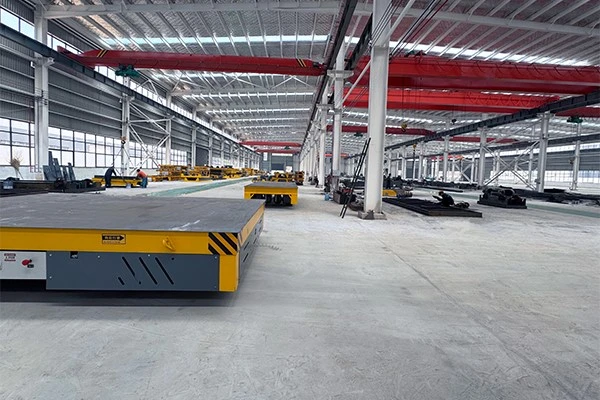
Core Features of Semi-Automatic Projects
Suitable for customers with limited budget but basic automation demands
Flexible for frequently adjusted traveling routes
Supports multi-point stopping requirements
Perfect for working sites with regularly changed parking positions


