

What Is a Self-Propelled Transfer Cart?
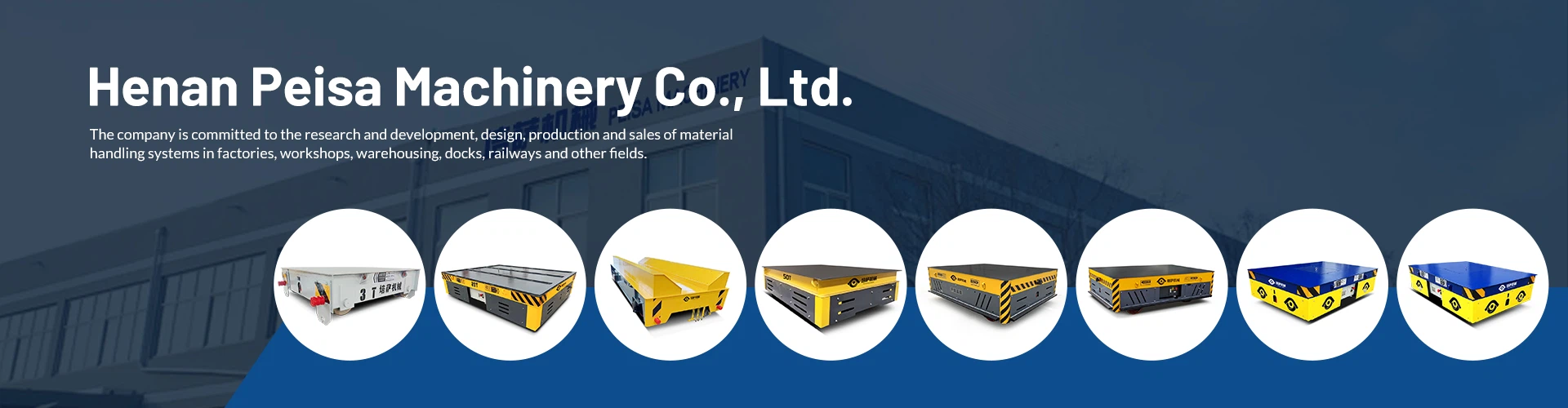
A self-propelled transfer cart, as referred to by our customers, is a type of handling equipment that can move under its own power without the need for an external towing vehicle. It usually refers to our trackless transfer carts.
These carts are widely used in various industries, especially in heavy industry, automotive manufacturing, and mechanical processing.
Unlike unpowered trailers, self-propelled transfer carts are independently driven devices designed to combine a power system with load-bearing capability, allowing them to complete handling operations without relying on other vehicles during transportation.
Advantages of Self-Propelled Transfer Carts: Background
Heavy cargo handling plays a crucial role in logistics and manufacturing processes, and the efficiency of the transportation system directly impacts labor costs and production efficiency.
While the traditional tractor-and-trailer model has been used for many years, increasingly complex working conditions and growing demands for efficiency and flexibility have led self-propelled transfer carts to gradually become an important alternative.


Differences from Traditional Trailers
Traditional trailers do not have their own power and must rely on towing equipment to complete transportation operations.
Their overall structure is relatively simple, usually consisting of a frame, wheels, and a tow bar, which results in relatively low cost.
However, in actual use, trailers are highly dependent on towing equipment, and their efficiency and flexibility are limited under heavy loads or complex working conditions.


Main Advantages of Self-Propelled Transfer Carts
1. Higher Load Capacity
Self-propelled trackless transfer carts are typically designed to support higher load capacities.
Peisa Machinery supports customized load capacities ranging from 1 to 500 tons, equipped with high-performance motors and reducers, enabling the easy transportation of large and heavy goods both inside and outside the workshop.
In contrast, although trailers can also be customized in terms of load capacity, their actual performance is highly dependent on the towing capability of the tractor. Under heavy loads, issues such as slow startup and reduced efficiency are more likely to occur.
2. Greater Flexibility and Ease of Operation
In a trailer system, vehicle movement and steering are entirely controlled by the towing vehicle. In confined spaces or situations involving frequent turns, operation becomes more difficult and can easily lead to delays.
Self-propelled transfer carts have independent driving capabilities, making them much easier to maneuver in confined spaces.
Peisa Machinery's transfer carts support customized differential steering, allowing 360° in-place rotation, which offers significant advantages for internal factory transportation.
3. Smaller Footprint and Higher Transportation Efficiency
The transfer carts do not require additional towing equipment, resulting in a more compact overall structure and a smaller footprint.
At the same time, their higher travel speed and flexible steering allow them to complete transportation tasks in a shorter time, thereby improving overall operational efficiency.
4. More Stable Operation and Higher Safety
All driving, starting, stopping, and braking processes of a self-propelled transfer cart are managed by its own control system, making operation more stable and controllable.
During heavy-load transportation, the vehicle offers better stability, which also helps reduce risks associated with manual operation.


Applications of Trackless Transfer Carts

Heavy manufacturing industry: Commonly used for cross-regional handling of heavy workpieces, equipment, and various molds.
Industrial production workshops: An ideal solution for efficient material transfer within workshops.
Warehousing and logistics environments: Efficiently completes short-distance transportation between warehouses and production areas.
Power and energy industry: Used for handling power equipment, transformers, and other components, as well as various heavy-duty parts.
Conclusion
Self-propelled transfer carts offer significant advantages in heavy-load handling applications, including high efficiency, strong flexibility, stable operation, and improved environmental performance.
Compared with traditional trailers, self-propelled material transfer carts provide faster, safer, and more efficient transportation solutions while effectively reducing labor costs and delivering better overall economic benefits.
For companies seeking more efficient and flexible industrial transportation solutions, Peisa Machinery's self-propelled transfer carts are a practical option worth considering.


