

Is the steering of a trackless transfer cart related to the wheel material?
This question confuses many users, but the answer is clear: the steering system and wheel material are not directly related. They are two independent systems that work together during operation but do not interfere with each other.
Simply put:
The steering system determines the cart's turning ability-whether it turns with a large or small radius, or even rotates in place.
The wheel material determines load capacity and stability, which depends mainly on the ground conditions.
The two systems complement each other but do not limit each other.

1. Steering Systems: Responsible Only for Direction Control
Currently, there are three mainstream steering methods for trackless transfer carts. While their principles differ, their goal is the same: to move the cart in the desired direction.
Hydraulic Steering
This system uses hydraulic cylinders to push the wheels to a turning angle-typically around 40 degrees-similar to a car or truck. Only the front wheels steer, while the rear wheels drive. This method is suitable for low-speed, high-load applications, making it ideal for heavy material transfers in factory workshops.
Differential Steering
This method controls turning by adjusting the speed difference between the left and right wheels. For example, if the left wheel rotates slower and the right wheel faster, the cart naturally turns. This system requires no additional steering mechanism, which lowers manufacturing costs. It is generally used for lighter loads and in space-constrained areas, but it requires precise motor and control systems.
All-Wheel Steering
This is the most flexible system. Each wheel has an independent motor, allowing full control of its steering angle. The cart can move sideways, diagonally, or even rotate on the spot, making it suitable for confined spaces or complex routes. However, its more complex structure also makes it more expensive.
2. Wheel Selection: Based on Surface, Load, and Practical Needs
Wheel choice is not related to the steering method-it depends only on:
Load capacity
Heavy loads → treaded tires or high-strength rubber wheels
Light loads → polyurethane wheels
Surface conditions
Smooth epoxy floors → polyurethane wheels (to protect surfaces)
Rough or gravelly floors → soft rubber wheels (for shock absorption and durability)
Floors with track grooves, thresholds, or height differences → large-diameter treaded tires (to cross obstacles smoothly)
Special requirements
Some customers require features such as low noise, non-marking wheels, or oil resistance-these factors also guide wheel selection.
3. How Do Steering and Wheels Work Together?
The steering system controls direction, while the wheels ensure smooth movement under load. They work in coordination through the vehicle's control system, each performing its specific role.
For example:
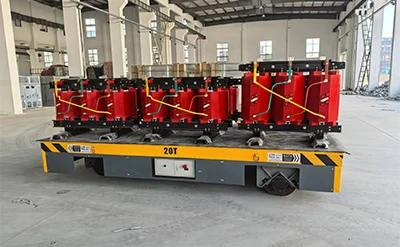
A hydraulic steering system with polyurethane wheels can efficiently move heavy molds in a workshop with flat floors.
A cart with all-wheel steering and treaded solid tires can flexibly transport building materials outdoors across uneven surfaces.
Summary
When selecting a trackless transfer cart, don't mix up steering systems and wheel materials:
First, choose a steering method based on your route and available turning space.
Then, choose the wheel type according to load capacity and ground conditions.
This step-by-step approach ensures reliable performance.
If you are still unsure about the best configuration, PEISA Machinery can provide a detailed workload analysis to recommend the optimal steering–wheel combination for your needs.


