

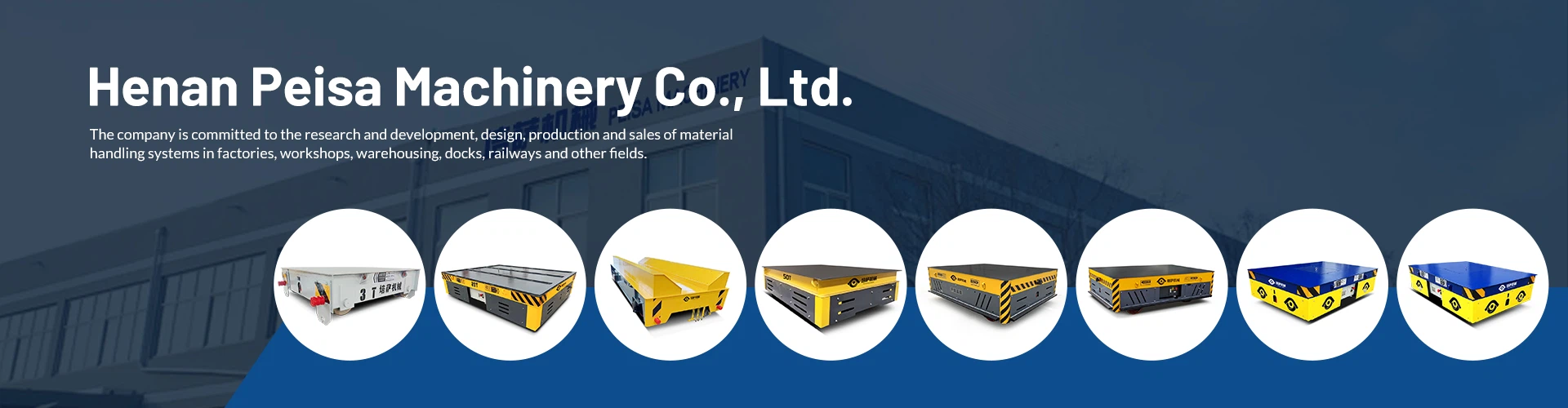
In today's manufacturing industry, the efficiency of workpiece transportation directly impacts overall production rhythm and operational efficiency. Compared to traditional forklifts and rail-mounted transfer carts, self-propelled transfer carts-offering flexibility, safety, and customizability-are gradually becoming key equipment for internal logistics upgrades across various industries.
Today, we'll explore the practicality of this equipment in three major application scenarios: the steel industry, food production lines, and machinery manufacturing.
I. Steel Industry: An Ideal Choice for Heavy-Duty Environments

In the steel industry, the transfer of raw materials, semi-finished products, and finished products often involves challenges related to heavy loads and low transportation efficiency. Traditional methods like overhead cranes or rail-mounted flatcars, while stable, have limitations in flexibility and space utilization.
Our flexible, steerable transfer carts offer strong adaptability in this scenario. With a high-load-bearing steel structure and a high-quality drive system, they enable the smooth transportation of steel coils, castings, or molds weighing hundreds of tons.
With wireless remote control, operators can complete transportation tasks from a safe distance, avoiding prolonged exposure to hazardous areas. Additionally, the compact design allows for flexible maneuvering in confined spaces, effectively improving overall material handling efficiency.
II. Food Production Lines: Intelligent and Efficient Material Handling

In the food processing and packaging sector, companies with demanding layouts and stringent requirements have strict standards for the cleanliness and precision of their transport equipment.
To meet these demands, self-propelled transfer carts use high-quality platform surfaces and corrosion-resistant designs to comply with hygiene standards. These carts operate smoothly with low noise, precisely navigating narrow production aisles and efficiently connecting materials from production and packaging areas to storage.
Some models can be equipped with automatic navigation systems (using magnetic strip guidance), allowing for unmanned operation along the entire transport line. This significantly reduces labor costs and potential safety risks. For food companies, this not only optimizes production cycles but also enhances overall safety management.
III. Machinery Manufacturing Industry: Flexible and Diverse Workpiece Transfer

Machinery manufacturing companies produce a wide variety of materials, ranging from large machine frames to precision components, with significant differences in weight and size. Our trackless transfer carts, with their high degree of customization, can be designed with custom clamps or support platforms to suit the shape of the workpiece.
Some of these trackless transfer carts can perform lateral movement, diagonal movement, and in-situ rotation, making them well-suited for complex workshop environments with multiple workstations and channels.
Additionally, transfer carts equipped with high-capacity batteries and intelligent control systems can support long-term continuous operation and provide real-time monitoring of equipment status. This significantly improves equipment utilization and transport controllability.
Conclusion
From steel to food, from heavy industry to precision manufacturing, self-propelled transfer carts are becoming core equipment for upgrading internal logistics due to their intelligent and customizable advantages.
In ever-changing production environments, these carts not only represent a revolution in transportation methods but also symbolize the efficiency and safety of the trends of "flexible manufacturing" and "smart factories."
If your industry also faces complex material handling challenges, consider the intelligent solutions offered by self-propelled transfer carts. They can make transportation more efficient and production smoother.


