In the industrial sector, drying products after spray painting is an essential step and a crucial element of the finishing process. Transporting heavy materials or equipment into the drying room presents a challenge. Rail transfer carts offer an excellent solution. Different rail transfer cart configurations can be designed to meet various drying room requirements. This article details the advantages and disadvantages of these solutions.
1. Rail Transfer Cart + Trailer
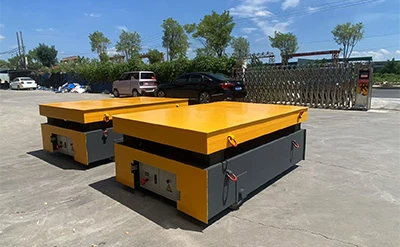
This system combines a powered flatbed cart with an unpowered flatbed trailer. The rail transfer cart is driven by a motor, which in turn pulls the rail trailer. Materials are placed on the rail trailer and moved along the tracks. After transporting the goods to the drying room, the rail transfer cart automatically exits, leaving the materials and the rail trailer inside.
Features:
The rail transfer cart is equipped with a motor, power system, drive system, and control system; it travels along a rail system.
The rail trailer has a simple structure, consisting of a load-bearing frame and wheel system.
Advantages:
Low cost, simple maintenance, high stability, smooth transport, and high safety. It is suitable for linear material transport within the drying room and between workshops.
2. Hydraulic Lifting Transfer Cart
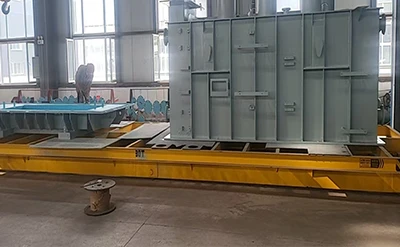
This design features lifting capabilities. Equipped with a hydraulic lifting system, the transfer cart raises materials or equipment to a specific location, then exits the drying room, leaving the pallet and cargo inside.
Features:
Its low profile allows for flexible access under the pallet. The hydraulic lifting mechanism can raise the pallet to a height of 50–300 mm, enabling successful transport into the drying room.
Advantages:
High space utilization, flexibility, and support for multi-point transport. The initial investment is relatively high, but the track navigation is highly accurate. This solution is suitable for drying rooms used in video, electronics, and storage industries.