

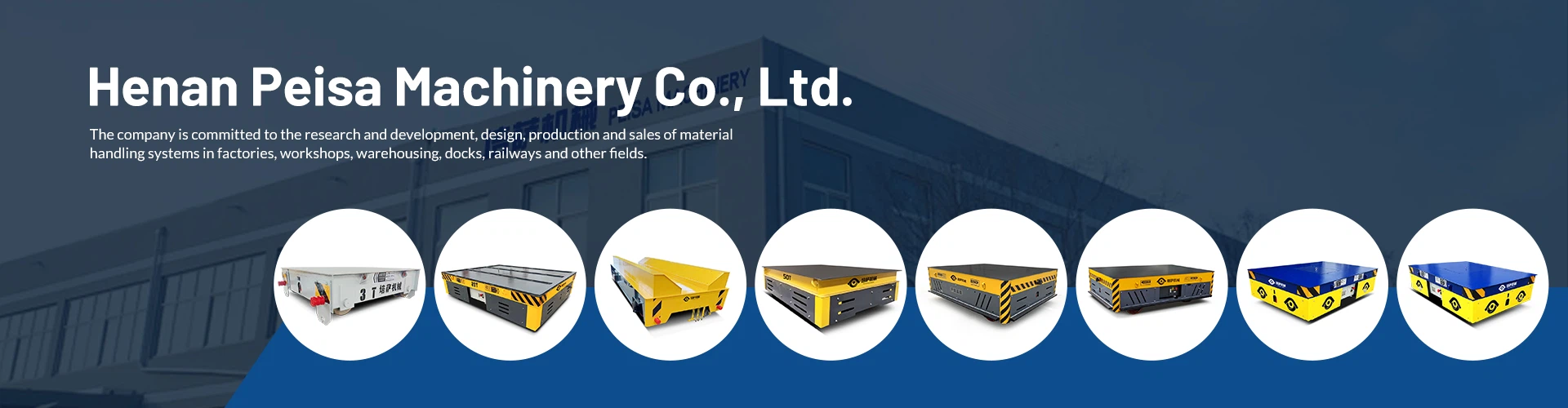

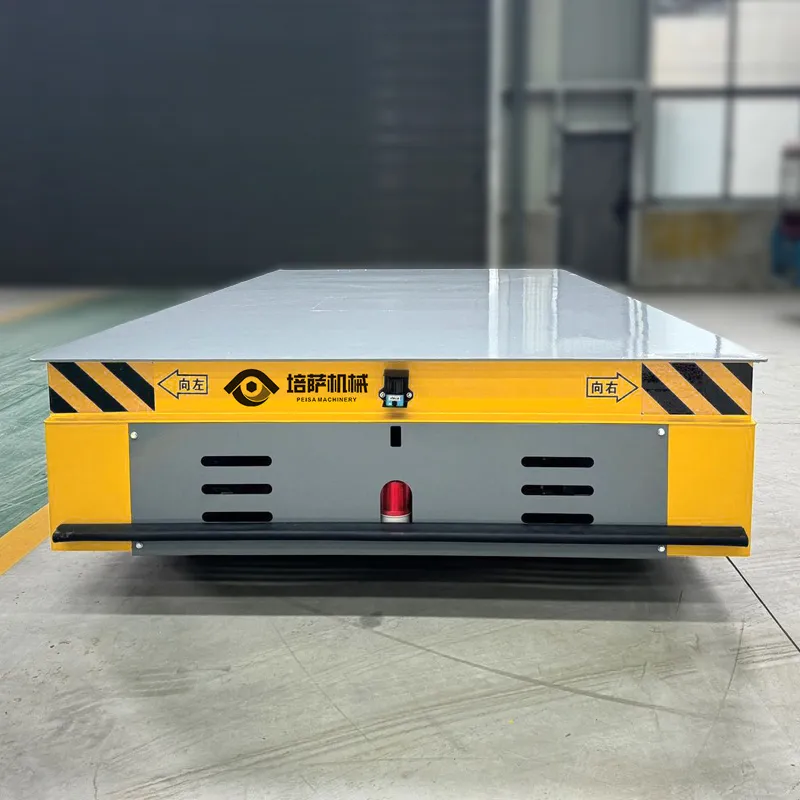
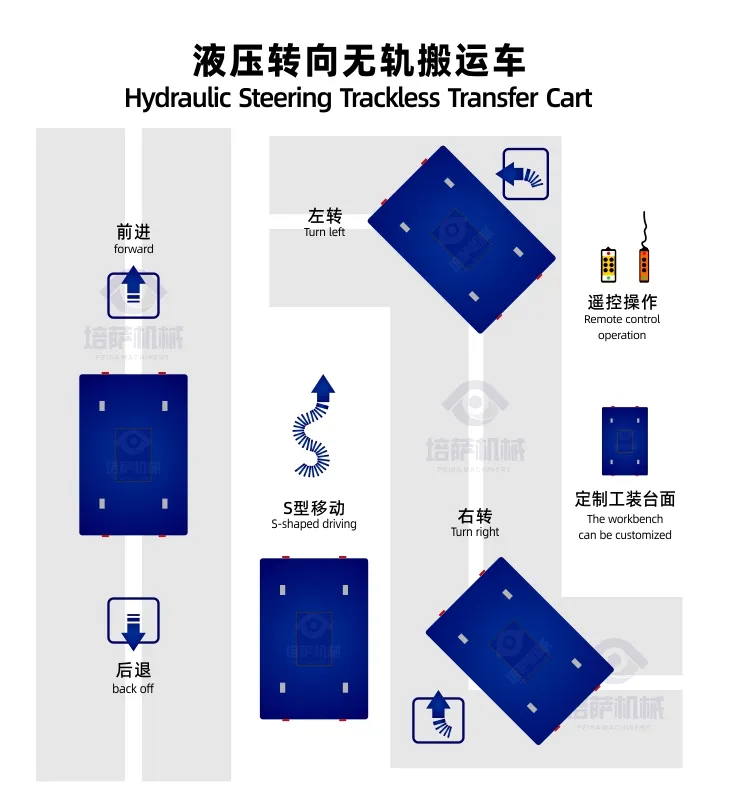
The Hydraulic Steering Transfer Cart is one of the most widely used products in the DWP series. Unlike differential steering systems, this cart uses hydraulic cylinders to control wheel steering and change the direction of travel.
It is known for its excellent stability. Although it is not as flexible as differential steering systems, it offers superior straight-line tracking performance. Therefore, it is an ideal solution for transporting precision instruments or moving equipment that requires a high level of stability and smooth operation.
The Hydraulic Steering Transfer Cart is composed of a battery, motor-reducer unit, steel frame, electrical control system, remote control system, and running mechanism. Its relatively simple structure also makes future maintenance and servicing more convenient.
In addition, the battery-powered design allows the cart to move freely between two or more separate workshops. With mature battery technology, the system can operate under full load for 4 to 6 hours continuously.

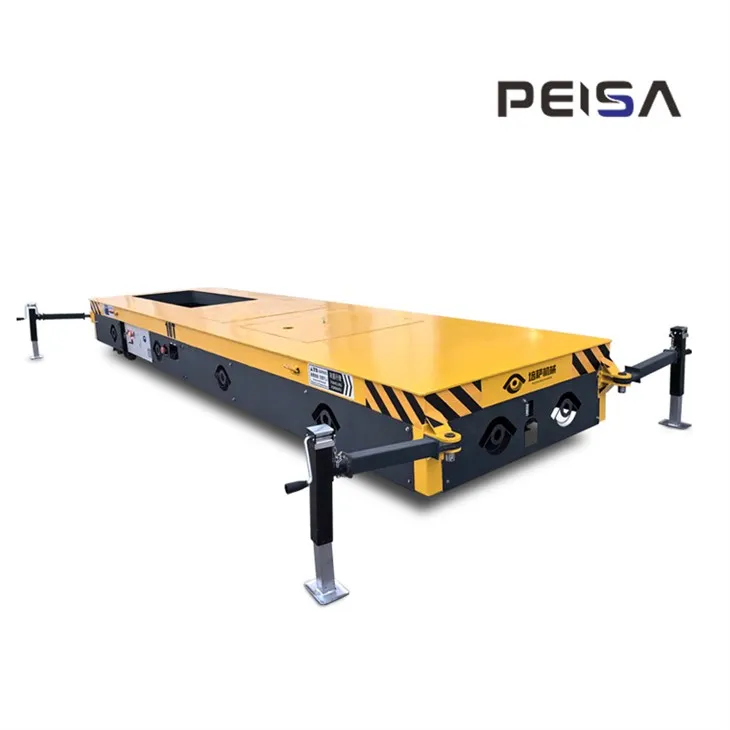
10-Ton Hydraulic Steering Transfer Cart for a Client in the Netherlands
As shown in the accompanying image, this is a custom-designed 10-ton battery powered electric transfer cart manufactured for a client in the Netherlands. It operates in a port environment and is used to transport heavy cable reels that supply power to ship hulls. Therefore, operational stability was a critical requirement.

One of the main engineering challenges for this project was related to the cable winding process. As the heavy cables are spooled in and out, they generate dynamic pulling forces on the cart. In addition, the port environment is exposed to strong winds. We had to carefully consider the combined effect of these factors, especially the risk of swaying or instability during operation.
To address this issue, we installed four stabilizing outriggers at each corner of the cart to ensure secure and stable operation.
The cart also features an ultra-narrow design, as it must pass through a restricted channel with a clearance of only 1.6 meters. Therefore, the total width had to be strictly controlled. Considering additional side obstructions in the working area, the final design width was optimized to 1.3 meters.
| Item | Differential Steering Transfer Cart | Hydraulic Steering Transfer Cart |
|---|---|---|
| Steering Principle | Changes direction by controlling different wheel/motor speeds on left and right sides | Changes direction by hydraulic cylinders driving the steering axle/wheels |
| Turning Radius | Very small, can achieve 360° rotation in place | Larger than differential steering, usually limited turning angle |
| Maneuverability | Excellent for narrow workshops and complex routes | Better for longer-distance transport with stable turning |
| Driving System | Usually dual-motor or multi-motor drive | Motor drive + hydraulic steering system |
| Steering Accuracy | High flexibility, suitable for precise positioning | Smooth steering, stable direction control |
| Suitable Load Range | Medium to heavy loads (commonly 1–50 tons, can be customized) | Heavy-duty loads, suitable for larger tonnage (commonly 10–150 tons, can be customized) |
| Speed Control | Easy to realize variable speed and fine control | Stable speed control, better for continuous transport |
| Floor Requirement | Requires relatively flat ground for best performance | Stronger adaptability to uneven ground conditions |
| Maintenance | Lower mechanical complexity, mainly motor and control maintenance | Higher complexity due to hydraulic system, requires oil maintenance |
| Cost | Usually lower cost | Higher cost due to hydraulic steering components |
| Best Application | Tight spaces, frequent turning, workshop material handling | Heavy loads, longer routes, stable steering requirements |

Process to Obtain a Customized Transfer Cart Solution
1. Define your requirements
Clarify the load capacity, platform dimensions, operating method, and working environment conditions.
2. Contact the PEISA sales team
Reach out to our sales representatives for initial communication.
3. Discuss detailed requirements and receive a quotation
We will review your needs in detail and provide a quotation accordingly.
4. Confirm technical specifications and drawings
After technical confirmation, we will issue detailed drawings for your approval before production.
Hot Tags: hydraulic steering transfer cart, China hydraulic steering transfer cart manufacturers, factory, trackless column parts transfer cart, trackless box transfer system, trackless transfer equipment, trackless part transfer system, trackless componentry transfer system, trackless stock movement cart


