

The maximum gradient an Equipment Transfer Cart can climb is a critical consideration for industries relying on these carts for material handling and equipment transportation. As a leading supplier of Equipment Transfer Carts, we understand the importance of this factor and have extensive knowledge to share on this topic.
Understanding the Basics of Equipment Transfer Carts
Equipment Transfer Carts are designed to move heavy loads across factory floors, warehouses, and other industrial settings. They come in various types, including rail - powered, battery - powered, and cable - reel powered carts. Each type has its own set of characteristics that influence its climbing ability.

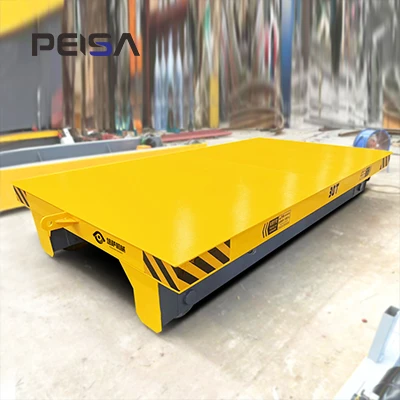
Rail - powered transfer carts, such as the Transfer Cart For For Handling Steel Plate, run on rails, which provide a stable and guided path for the cart. The rails help in distributing the weight of the load evenly and also reduce friction, allowing the cart to move more efficiently. These carts are often used for transporting heavy and large - sized equipment, like steel plates.
Battery - powered carts, on the other hand, offer more flexibility as they can move freely without the need for a fixed rail system. However, their climbing ability may be affected by the battery capacity and the power of the electric motor. The Abrasive Blasting Transfer Cart is an example of a specialized battery - powered cart used in specific industrial processes.
Factors Affecting the Maximum Gradient
Several factors determine the maximum gradient an Equipment Transfer Cart can climb.
- Load Weight: The heavier the load, the more difficult it is for the cart to climb a gradient. A fully loaded cart will require more power to ascend a slope compared to an empty one. Our Equipment Transfer Cart is engineered to handle different load capacities, but the gradient it can climb will vary depending on the actual weight being carried.
- Power Source: The power source of the cart plays a crucial role. Rail - powered carts can draw a consistent power supply from the rails, which may allow them to handle steeper gradients compared to battery - powered carts. Battery - powered carts are limited by the energy stored in the battery, and climbing a steep gradient can quickly drain the battery.
- Traction: Traction is the grip between the wheels of the cart and the surface it is moving on. For rail - powered carts, the contact between the wheels and the rails provides traction. However, factors such as rail condition (e.g., presence of dirt or debris) can affect traction. In the case of non - rail carts, the type of tires and the surface texture of the floor are important for maintaining traction.
- Mechanical Design: The mechanical design of the cart, including the gear ratio and the efficiency of the motor, also impacts its climbing ability. A well - designed cart with a proper gear ratio can transfer power more effectively to the wheels, enabling it to climb steeper gradients.
Calculating the Maximum Gradient
To calculate the maximum gradient an Equipment Transfer Cart can climb, we need to consider the following formula:
[ \text{Gradient} (%)=\frac{\text{Vertical Rise}}{\text{Horizontal Distance}}\times100 ]
In practical terms, we also need to take into account the power available from the power source and the resistance forces acting on the cart. Resistance forces include friction, air resistance (although this is usually negligible in industrial settings), and the force required to move the load uphill.
Let's assume a rail - powered Equipment Transfer Cart with a certain power output and a known load capacity. We can use the following steps to estimate the maximum gradient:
- Determine the maximum tractive force the cart can generate. This is based on the power of the motor and the mechanical efficiency of the cart.
- Calculate the gravitational force acting on the load when the cart is on a slope. The gravitational force component acting parallel to the slope is given by (F = mg\sin\theta), where (m) is the mass of the load, (g) is the acceleration due to gravity ((9.81m/s^{2})), and (\theta) is the angle of the slope.
- Set the maximum tractive force equal to the gravitational force component acting parallel to the slope plus the frictional force. By solving for (\theta), we can find the maximum angle of the slope, and then convert it to a gradient percentage.
Industry Standards and Best Practices
In the industrial equipment industry, there are no one - size - fits - all standards for the maximum gradient an Equipment Transfer Cart can climb. However, most manufacturers provide guidelines based on the design and specifications of their carts.
It is best practice to conduct a site survey before installing an Equipment Transfer Cart. This survey should include an assessment of the floor or rail conditions, the expected load weights, and the required gradients. Based on this information, we can recommend the most suitable type of cart and its specifications.
Real - World Examples
Let's consider a case where a manufacturing plant needs to move heavy machinery between different levels of a building. The plant has a rail system in place, and they are considering using our Equipment Transfer Cart. After a detailed analysis of the load weights (which range from 5 to 10 tons) and the available power supply, we determine that the cart can safely climb a gradient of up to 5% when fully loaded.
In another scenario, a warehouse uses a battery - powered Equipment Transfer Cart to move smaller loads. Due to the limited battery capacity, the cart can only handle a gradient of up to 3% without significant battery drain.
Conclusion
The maximum gradient an Equipment Transfer Cart can climb is a complex function of multiple factors, including load weight, power source, traction, and mechanical design. As a supplier of Equipment Transfer Carts, we are committed to providing our customers with the most accurate information and the best - suited solutions for their specific needs.
If you are in the market for an Equipment Transfer Cart and need to understand the maximum gradient it can handle for your application, we invite you to contact us for a detailed consultation. Our team of experts will work with you to assess your requirements and recommend the ideal cart for your operations.
References
- Industrial Equipment Handbook, 3rd Edition
- Journal of Material Handling and Logistics, Vol. 15, Issue 2
- Manufacturer's Specifications for Equipment Transfer Carts