

Hey there! As a supplier of towed transfer carts, I often get asked about the heat-dissipation system in these nifty machines. So, let's dig into what the heat-dissipation system of a towed transfer cart is all about, and why it matters.
First off, you might be curious why a towed transfer cart even needs a heat-dissipation system. Well, just like any piece of machinery with moving parts and electrical components, these carts generate heat during operation. Motors, batteries (if it's an electric one), and other components can heat up as they work. If this heat isn't properly managed, it can lead to a bunch of problems. Overheating can reduce the efficiency of the cart, cause premature wear and tear on parts, and in the worst-case scenario, it could even lead to a breakdown.
Now, let's talk about how the heat-dissipation system actually works. There are a few different methods that are commonly used, and I'll walk you through each one.
Natural Convection
One of the simplest forms of heat dissipation is natural convection. It's a fancy term for allowing the heat to transfer from the hot components to the surrounding air. In a towed transfer cart, this usually means having well-ventilated compartments for the motor and battery. Holes and gaps are strategically placed in the cart's housing to allow air to flow in and out. As the hot air rises, it escapes through the top vents, and cooler air is drawn in from the bottom. It's like a natural air conditioning system, but it relies on the basic principles of physics. This method is low-cost and doesn't require any additional power, but it may not be sufficient for carts that operate in high-temperature environments or those with high-power components.

Forced Air Cooling
When natural convection isn't enough, forced air cooling comes into play. This involves using fans to blow air over the hot components. In a towed transfer cart, you might find small fans installed near the motor or the battery pack. These fans work by increasing the airflow around the components, which helps to carry away the heat more quickly. Forced air cooling is more effective than natural convection, especially in confined spaces or when the cart needs to operate for extended periods at high loads. However, it does require a power source for the fans, which can add to the cart's energy consumption.
Liquid Cooling
For some heavy-duty towed transfer carts, liquid cooling is the way to go. This system uses a coolant, usually a mixture of water and antifreeze, to absorb the heat from the components. The coolant circulates through a series of pipes and channels that are in contact with the hot parts, such as the motor. As the coolant absorbs the heat, it is pumped to a radiator, where it releases the heat into the surrounding air. Liquid cooling is very efficient at removing heat and can keep the components at a more stable temperature. It's commonly used in high-performance carts or those that operate in extreme conditions. But it's also more complex and expensive to install and maintain compared to the other methods.
The Importance of a Good Heat-Dissipation System
Having a well-designed heat-dissipation system is crucial for the performance and longevity of a towed transfer cart. When the components are kept at a proper operating temperature, the cart can work more efficiently. This means better energy consumption, which can save you money in the long run. It also reduces the risk of breakdowns, which can lead to costly downtime. Imagine if your cart suddenly stops working in the middle of a busy day at the factory. That could disrupt your entire production line!
Our Towed Transfer Carts and Heat Dissipation
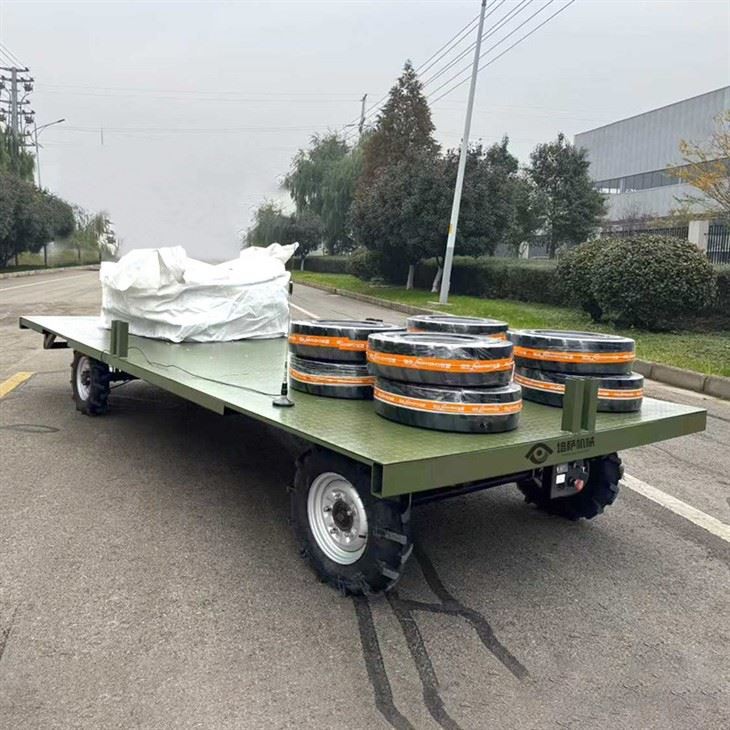
As a supplier, we take heat dissipation seriously. We make sure that all our towed transfer carts are equipped with the appropriate heat-dissipation systems based on their intended use. Whether it's a Heavy Duty Flatbed Trailer that needs to carry heavy loads over long distances or a Rail Turntable Transfer Cart that operates in a confined space, we've got you covered. Our Unpowered Trailer models also have proper ventilation to ensure that any heat generated by friction or other factors can be dissipated effectively.
Contact Us for Your Towed Transfer Cart Needs
If you're in the market for a towed transfer cart, or if you have any questions about our heat-dissipation systems, don't hesitate to reach out. We're here to help you find the perfect cart for your specific requirements. Whether you need a small cart for a workshop or a large, heavy-duty one for an industrial setting, we can provide you with the right solution. Our team of experts can work with you to understand your needs and recommend the best heat-dissipation system for your cart. So, why wait? Let's start the conversation and get you the towed transfer cart you need.
References
- "Thermal Management in Industrial Equipment." Industrial Machinery Handbook, 2023.
- "Cooling Systems for Electric Vehicles." Electric Vehicle Technology Journal, Vol. 15, 2022.