

Hey there! I'm a supplier of Rail Transfer Trolleys, and today I want to chat about a question I often get asked: Can a rail transfer trolley be used for transporting liquid - filled containers?
First off, let's understand what a rail transfer trolley is. It's a nifty piece of equipment that runs on rails, designed to move heavy loads from one place to another in industrial settings. It's got a wide range of applications, like in factories, warehouses, and even some large - scale construction sites.
Now, the idea of using it for liquid - filled containers is quite interesting. There are a few factors we need to consider when answering this question.
Safety First
Safety is the biggest concern when it comes to transporting liquid - filled containers. Liquids can be volatile, and any spillage can be a huge problem. It can cause environmental damage, create slippery surfaces which are a safety hazard for workers, and in some cases, if the liquid is flammable or toxic, it can lead to serious accidents.
Our rail transfer trolleys are built with a sturdy structure. They have a stable base that can handle the weight of the liquid - filled containers. But we also need to make sure that the containers themselves are properly secured. We can use special clamps or restraints to hold the containers in place during the transfer. This helps prevent the containers from tipping over or shifting around, which could lead to spills.
Compatibility with Container Types
There are different types of liquid - filled containers, such as drums, tanks, and IBCs (Intermediate Bulk Containers). Our rail transfer trolleys can be customized to accommodate these different container types.
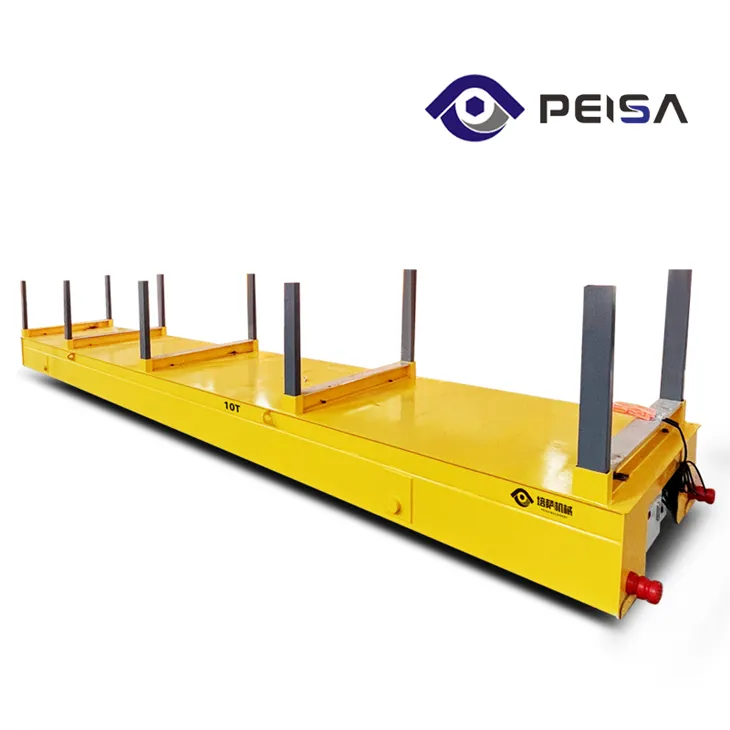

For drums, we can design a trolley with a platform that has depressions or holders specifically sized for the drums. This keeps them in position and reduces the risk of rolling.
Tanks and IBCs are usually larger and heavier. We can build a trolley with a flatbed that has enough space to hold these big containers. We can also add side guards to prevent the containers from falling off the trolley during movement.
Movement and Stability
One of the key features of our rail transfer trolleys is their smooth movement. They are powered by reliable motors that ensure a steady speed. When transporting liquid - filled containers, a smooth and stable movement is crucial. Sudden stops or starts can cause the liquid inside the containers to slosh around, increasing the risk of spills.
Our trolleys are equipped with advanced control systems that allow for precise speed control. This means we can start and stop the trolley gradually, minimizing the sloshing effect. The rails also provide a stable path for the trolley, reducing the chances of it veering off course and causing an accident.
Maintenance and Inspection
Regular maintenance and inspection are essential when using a rail transfer trolley for transporting liquid - filled containers. We need to check the condition of the trolley's wheels, motors, and control systems on a regular basis. Any signs of wear and tear should be addressed immediately to ensure the safe operation of the trolley.
We also need to inspect the container - securing mechanisms. Make sure the clamps and restraints are in good working condition and can hold the containers firmly. If there are any leaks or damages to the containers, they should be repaired or replaced before the next transfer.
Case Studies
Let's take a look at some real - world examples. In a chemical plant, they use our Railroad Transfer Cart to move drums of chemicals. The cart was customized with special drum holders and a stable platform. Since they started using it, the number of spill incidents has significantly decreased.
Another example is a food processing factory. They use our Transfer Cart For Steel Plant (even though the name might be a bit misleading here) to transport large IBCs filled with liquid food products. The cart's smooth movement and reliable container - securing system have ensured that the products are transferred safely without any contamination or spills.
Advantages of Using Rail Transfer Trolleys for Liquid - Filled Containers
There are several advantages to using our rail transfer trolleys for this purpose. Firstly, they are cost - effective. Compared to other types of transportation equipment, rail transfer trolleys are relatively inexpensive to purchase and operate. They have low energy consumption and require less maintenance.
Secondly, they are very efficient. They can move the liquid - filled containers quickly and accurately to the desired location. This helps improve the overall productivity of the industrial process.
Finally, they are environmentally friendly. Since they run on rails, they produce less noise and emissions compared to some other forms of transportation.
Customization Options
As a supplier, we understand that every customer's needs are different. That's why we offer a wide range of customization options for our rail transfer trolleys. If you need a trolley for transporting small - sized liquid containers, we can design a compact and lightweight trolley. On the other hand, if you need to move large and heavy tanks, we can build a heavy - duty trolley with a high - load capacity.
We also offer different power options, such as battery - powered, low - voltage - powered, and cable - reel - powered trolleys. For example, our Low Voltage Coil Transfer Cart can be a great option for some applications, providing a safe and efficient power source.
Conclusion
So, to answer the question, yes, a rail transfer trolley can definitely be used for transporting liquid - filled containers. With proper safety measures, customization, and maintenance, it can be a reliable and efficient solution for moving these types of containers in industrial settings.
If you're interested in using our rail transfer trolleys for your liquid - filled container transportation needs, don't hesitate to reach out. We're here to help you find the best solution for your specific requirements. Let's have a chat and see how we can work together to improve your industrial transportation process.
References
- Industrial Transportation Handbook: This handbook provides in - depth knowledge about different types of industrial transportation equipment, including rail transfer trolleys.
- Chemical Safety Guidelines: These guidelines offer valuable information on the safe handling and transportation of liquid chemicals.
- Food Processing Industry Standards: These standards outline the requirements for transporting liquid food products safely and hygienically.