

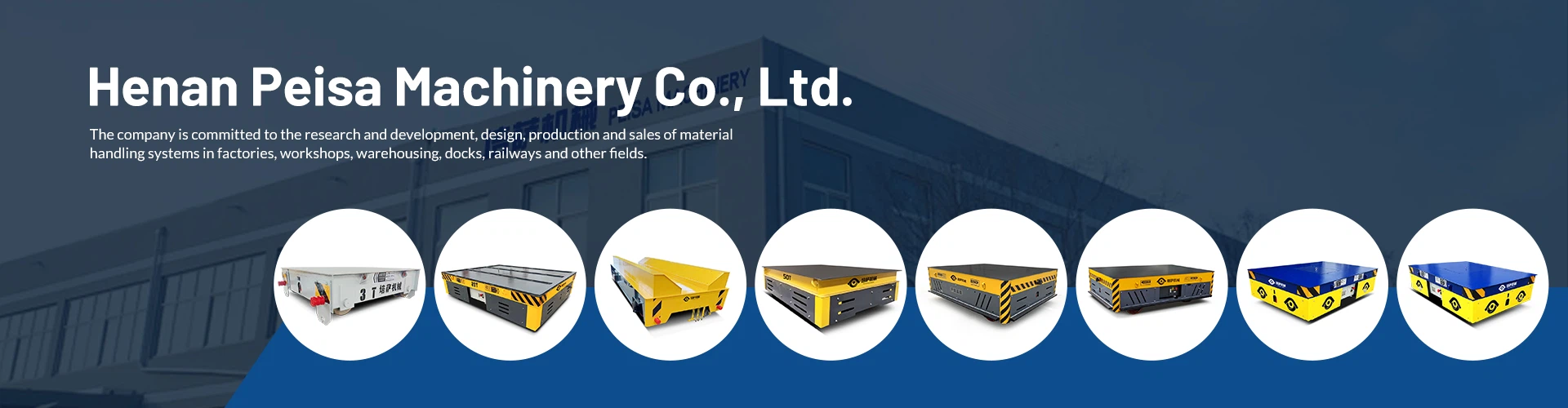

In heavy industrial workshops, steel mills, container factories, and equipment manufacturing plants, the transportation of 5–200 tons heavy-duty cargo is the core link affecting production efficiency. Many factory purchasers will hesitate when choosing handling equipment: whether to use a traditional forklift or a professional electric flat cart / heavy duty transfer trolley?
For light and small cargo, forklifts are flexible and applicable; but for large tonnage, super-long, super-wide, irregular heavy cargo, professional industrial electric flat carts have absolute advantages. This article analyzes why most large factories and engineering projects prefer electric flat carts instead of forklifts for heavy cargo handling.

1. Larger Load Capacity, More Stable Heavy-Duty Transportation
The load limit of a heavy-duty forklift in the market is usually 1–50 tons, and the price of a 30+ ton forklift is extremely high, with obvious load attenuation during actual operation. When transporting goods close to the limit load, the forklift will have problems such as body tilt and unstable center of gravity, which easily cause cargo tipping accidents.
By contrast, the battery powered electric flat cart is professionally designed for heavy-load handling. Its load range covers 5–200 tons, and customized super-large tonnage models are available. The whole vehicle adopts a low-center-of-gravity integrated frame structure, with the cargo evenly pressed on the full-carriage platform. There is no risk of load deviation, and the operation is stable and safe even with full-load operation for a long time, perfectly adapting to the long-term handling demand of large molds, steel coils, pressure vessels, and mechanical equipment.

2. Suitable for Special-Shaped & Oversized Cargo That Forklifts Cannot Handle
Forklifts rely on fork arms to support goods, which have strict restrictions on the shape, length and width of cargo. For ultra-long steel structures, ultra-wide container parts, integral large-scale mechanical equipment, and non-standard irregular heavy parts, forklift fork arms cannot fully bear the force, and it is impossible to complete stable loading and unloading and transportation.
The electric transfer cart adopts a fully flat platform design with no dead angle in bearing force. It can directly carry various oversized, super-heavy, and special-shaped workpieces. It does not need to adjust the fork distance or match the cargo specification, which solves the handling pain points that forklifts cannot cope with in heavy industry production.
3. Higher Safety Factor, Lower On-Site Operation Risk
Heavy-tonnage forklifts have high requirements for drivers' operation skills. When carrying heavy cargo, the sight is blocked, and there are hidden dangers such as side slip, rollover, and cargo falling during turning and braking. In narrow workshop passages and dense equipment areas, the operation risk is greatly increased.
Electric flat carts are ground-level walking handling equipment, with a low vehicle body and stable center of gravity, and zero rollover risk. Equipped with professional safety configurations such as emergency stop device, anti-collision sensor, sound and light alarm, and overload protection, it can automatically avoid obstacles and stop in emergency. Whether it is manual wired control, wireless remote control or automatic PLC control, it can realize safe operation without manual driving, effectively reducing industrial safety accidents.


